
Over the past 20 years, global farmed fish production has tripled and salmon production has increased 3.5-fold. Worldwide, aquaculture now produces more fish than wild-capture fisheries! But to raise so much fish, you have to... catch other fish!
Today, more than 15 million tonnes of small fish (anchovies, sardines and sardinella) are caught annually to be processed into meal and oil. This amount equals 15% of global catches and exceeds the total catch of the entire European Union.
These volumes have historically come from Peru and Chile, two countries with particularly rich fishing waters. But the intense growth of aquaculture has pushed the industry to diversify its supply sources. Now the waters of Morocco, Mauritania and Senegal are stepping in to meet this growing demand.
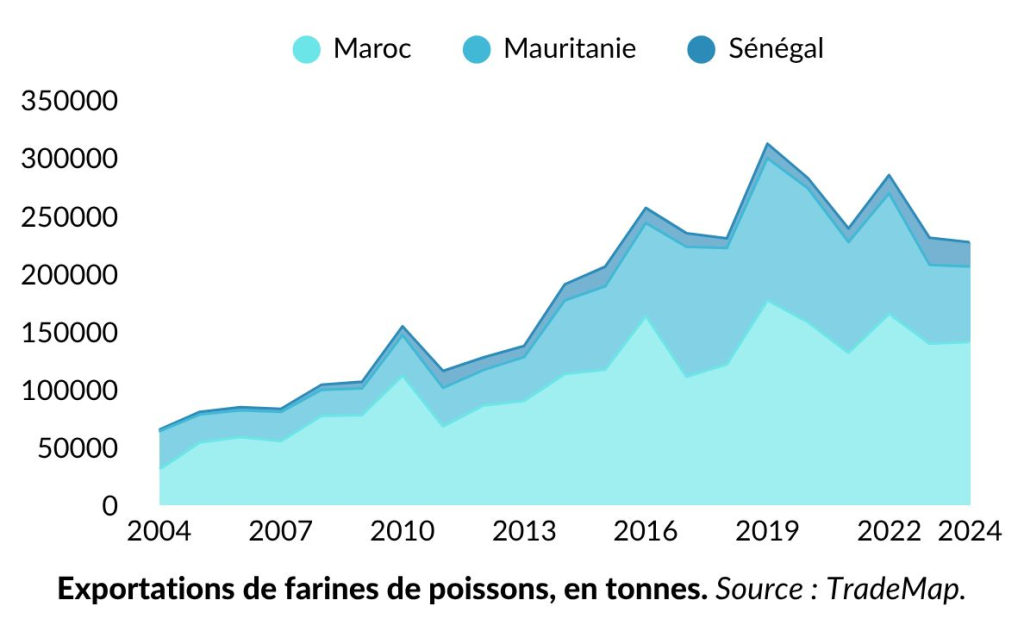
The problem is that this industry, which aims to feed Norwegian salmon, Spanish tuna or Chinese tilapia, is in direct competition with fishers and populations in West Africa.
The volumes of sardines and sardinella caught in West Africa to produce meal and oil are so enormous that they could cover the protein needs of the population of these 3 countries!
Overfishing, responsible for the collapse of fish populations and the destabilization of entire food chains, is today a real threat to our food security. This is particularly true in Senegal where seafood products represent 60% of the population's protein intake.
Paradoxically, this growing fish shortage in West Africa is offset by imports of farmed fish, such as tilapia from China... fed on fish caught in West Africa.
As our populations continue to grow demographically, it is urgent to ban, or at least severely restrict, these industries that destroy our ecosystems. This is also a matter of food sovereignty: rather than becoming increasingly dependent on imports of soy, industrial chicken and farmed fish, we could feed ourselves with our own sardines, which are moreover rich in Omega 3 and high-quality proteins.
The responsibility also falls on consuming countries, which should prioritize fish lower in the food chain, caught locally and without destructive fishing gear such as bottom trawling, which destroys the seabed.
This is also a matter of consistency: the European Union cannot be credible in supporting the food sovereignty of southern countries if its eating habits and its companies destroy the fish resources of these same countries.
Analysis by Ali Hatimy
Original publication on LinkedIn on 16/12/2025
Sources:
- Customs data: Trademap and UNComtrade (HS codes 230120 for meal, 1504 for oils).
- Reports and investigations: * FAO 2024 State of World Fisheries and Aquaculture.
- Investigations on impact in West Africa (Le Monde, Amnesty International).