
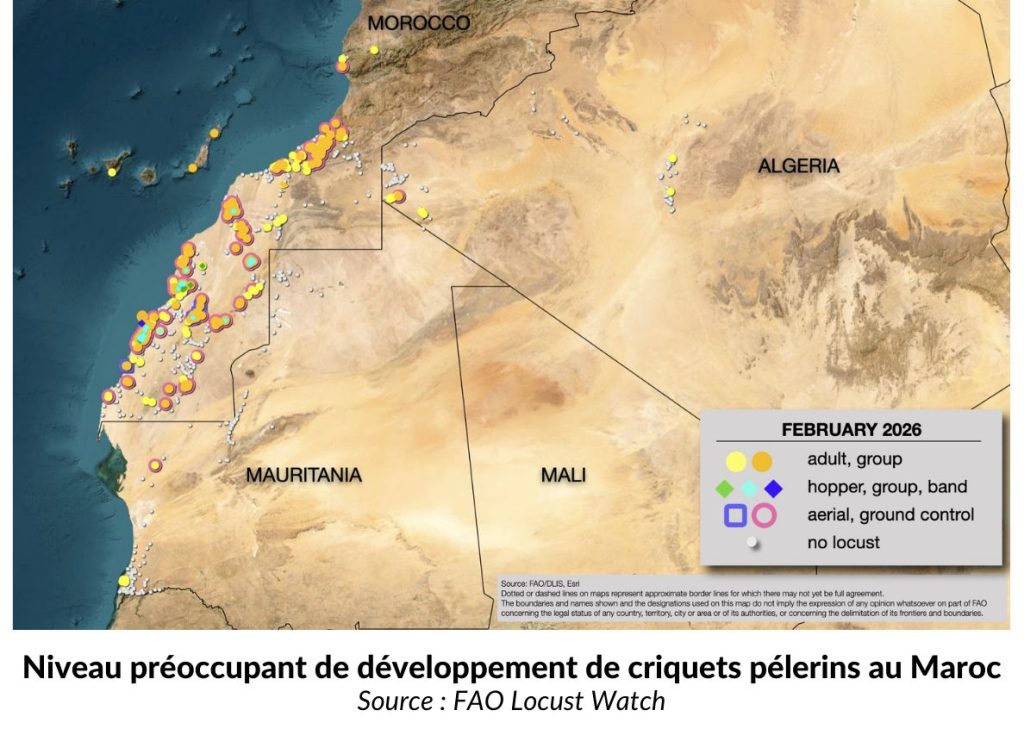
The risk of desert locust invasions has never been as high in Morocco for decades.
The desert locust is the most destructive migratory pest in the world. An individual is capable of consuming its own weight in vegetation each day and can move in swarms of several million individuals.
You can thus understand why this insect has contributed to numerous food crises throughout history and is even cited in the Quran and the Bible.
Without going back that far, in 2019-2020, a desert locust invasion devastated East Africa, notably with 200,000 hectares of agricultural land completely destroyed in Ethiopia.
In the 20th century, Morocco experienced 5 major invasions, the last of which occurred in 1987-1989 and required the mobilization of considerable material and financial resources (1 billion dirhams) to treat 5 million hectares.
Fortunately since then, desert locusts have caused no significant destruction in Morocco thanks to strong national expertise and early action in regulating this pest.
But the situation has been less favorable since March 2025.
First, it should be understood that the desert locust's biological cycle is divided into 3 major stages:
1 – the egg
2 – the larval stages, which are already insects capable of moving in bands of several million individuals
3 – the adult stage when the insect acquires its definitive wings. This stage is the most dangerous. A single square kilometer of swarm can contain 80 million adults and consume in one day the same quantity of food as 35,000 people!
In March 2025, it was essentially larval stages that were detected in the Draa and Ziz valleys.
But for the past few weeks, the adult stage, far more problematic, has been detected in Morocco's Saharan provinces, notably in Dakhla.
Why such development?
Unlike previous years, the 2025/2026 rainy season was particularly abundant in Morocco. Vegetation, and thus food availability for locusts, has been unusually plentiful.
We must therefore hope that control operations fulfill their role and that the weather in the coming months will be dry over the Saharan zones to limit locust development.
Analysis by Ali Hatimy
Original publication on LinkedIn on 12/03/2026