Table of Contents
The Moroccan Context
SMR, Latest Generation of Reactors
Technical and Economic Challenges
Echoes from Africa and the Middle East
Reality and Energy Needs
Morocco appears to be considering a new direction in its energy transition by betting on nuclear power. State media statements reflect a certain interest in SMRs as a new source of electricity production in the country. These reactors could offer certain advantages to Morocco, but at the cost of several technical and economic challenges.
The Moroccan Context
During 2023, many rumors related to a possible Moroccan civil nuclear market emerged in the country’s major newspapers. This was due to the visit of the International Atomic Energy Agency (IAEA) in December 2023[1] which concluded that Morocco is committed to maintaining and strengthening its regulatory framework for nuclear and radiological safety.
Following the favorable report submitted by IAEA experts, the Minister of Energy Transition and Sustainable Development, Ms. Leila Benali, has multiplied statements announcing that a vision had emerged within the government to explore the possibility of engaging in civil nuclear projects[2], and to add nuclear-generated electricity production to the country’s electricity mix, particularly through Small Modular Reactors (SMRs), in order to strengthen the energy transition in Morocco.
These statements did not go unnoticed at the European level, as several approaches have been undertaken by two main actors in European civil nuclear energy. First Russia, through the signing of a cooperation agreement with Morocco[3] in the field of civil nuclear energy, notably Russian supervision and assistance in the creation and improvement of nuclear energy infrastructure. Then France, through the visit in April 2024 of Economy Minister Bruno Le Maire[4], which mentions the possibility of a partnership with Morocco on nuclear energy, and in particular small reactors using Nuward technology.
However, despite all this background noise, this is not the first time nuclear has been discussed in Morocco. Let us recall that in the late 1970s, the late King Hassan II had the ambition to launch a civil nuclear program to free Morocco from its energy dependence, particularly following the significant impact of the first oil shock of 1973-74. The project involved the construction of a first nuclear power plant on the Atlantic coast between Safi and Essaouira. Unfortunately, the drought and economic conditions of the 1980s put an end to this momentum.
What then is the substance of all these rumors and why is civil nuclear power resurfacing in Moroccan public debate? What are these SMRs that are much talked about and what technology lies behind them to attract so much attention? And what would ultimately be the role of civil nuclear energy in Morocco’s energy transition?
SMR, Latest Generation of Reactors
SMRs are part of a broad family of civil electricity generation nuclear power plants. These plants are based on electricity production systems divided into 3 independent circuits.
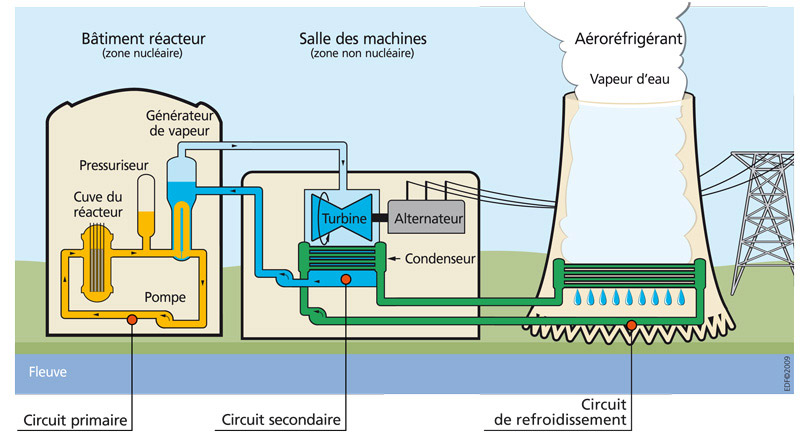
The primary circuit (yellow circuit in the diagram above) is a closed circuit that ensures the transmission of heat generated in the reactor core, where the fuel is located and the chain reaction takes place, to the steam generators which convert this heat into steam. The secondary circuit (blue circuit) is a closed circuit that carries the steam produced in the steam generators to the turbine of the turbogenerator set that produces electricity. Subsequently, the steam is converted back to water in the condenser. The cooling circuit (green circuit) supplies cold water to the condenser. This water, called the cold source, is drawn from a river, stream or sea[5].
The most widespread reactor technology in the world is the pressurized water reactor, or PWR. It accounts for approximately 70% of reactors installed or under construction in global nuclear parks. In France, for example, 100% of nuclear reactors are PWRs.
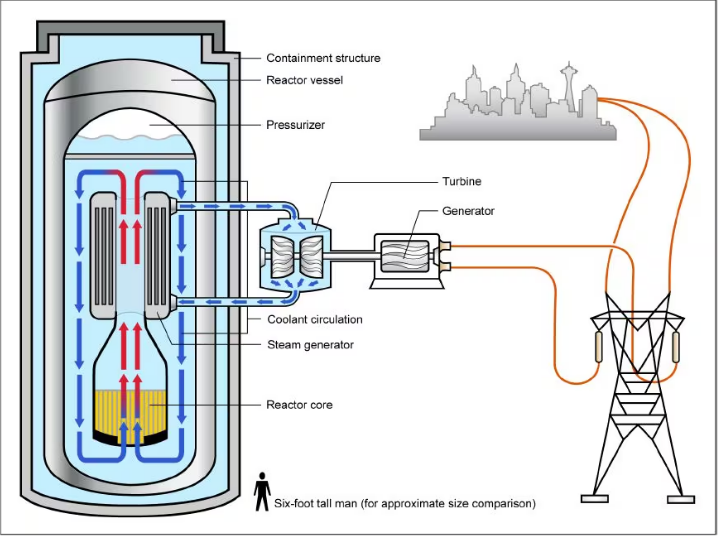
SMRs are a specific technology that has resulted from the operating principle of nuclear power plants. The reactor is the same but in a more compact version and therefore smaller in size: it contains within its submerged reactor both a pressurizer, steam generators, and the reactor core. An SMR also operates with much less fuel, and therefore capable of producing a lower amount of heat, which corresponds to much lower electricity production than large reactors. The range of an SMR varies between 70 and 470 megawatts electric (MWe).
The first distinctive feature of these reactors lies in their modularity, given that it is up to the client to choose the final electrical power they need. These SMRs can be considered as building blocks, sized to be complementary. If the need is for 300 MWe, 2 reactors of 150 MWe can be assembled and constructed at the same location to produce the electrical energy needed to feed into the grid.
The second distinctive feature of SMRs is their cost. Where a PWR of 1600 MWe can cost around 80 billion dirhams, a 300MW SMR will cost between 15 and 20 billion dirhams. The challenge for SMR is to ensure series production to reduce the cost per unit. Recent nuclear power plants reflect production costs exceeding 1000 dirhams/MWh in both the United States and Europe. However, momentum has been launched in the form of a technological race (development of new reactor generations) and industrial effort (implementation of modularity and standardization principles) to reduce the cost per MWh produced and get below the 1000 dirham threshold.
The third distinctive feature is reflected in the speed of constructability. Following the troubles of the French Flamanville 3 EPR, whose construction and startup duration stretched over some fifteen years against the planned 5 years, several countries are beginning to doubt the economic viability of nuclear power plant projects. SMRs have been announced as constructible in 3-4 years.
The fourth distinctive feature lies in their very high capacity factor. The capacity factor corresponds to the ratio of actual electrical production compared to what a reactor is supposed to produce at all times. For example, the capacity factor of a solar farm turned around 20% on average in 2024, while the capacity factor of a Moroccan hydroelectric dam has fallen in recent years to an average of 3%, due to lack of precipitation. SMRs would offer a capacity factor that could reach up to 90% on average annually.

This last advantage remains very interesting in the context of Morocco’s electrical transition, as it would make it possible to create an electricity production mix based on renewable energy, but given the intermittency of these renewables, SMRs could offset periods of low production by producing the electricity necessary to meet the demand of the Moroccan electrical grid. This mix could ensure electrical availability at all times, while offering a very low carbon footprint.
Indeed, the fifth distinctive feature of SMRs lies in its very low carbon footprint. Expressed per kWh produced, the carbon footprint of an SMR-type nuclear power plant is 5-15 gCO2 equivalent, compared to kWh produced by a gas power plant at 450-550 gCO2eq/kWh, and for a coal plant around 800-1000 gCO2eq/kWh. For renewable energy, the carbon footprint of a CSP solar plant is 8-20 gCO2eq/kWh, while for a wind farm it turns around 10-20 gCO2 equivalent[6].

One could thus envision a medium/long-term energy transition scenario where civil nuclear power, through SMR projects, could replace highly polluting coal and gas power plants given their high carbon footprint.
This solution also aligns with Morocco’s 2030 objective, which aims to have an installed renewable energy base of around 52% of the electricity mix. It would make it possible to both accelerate Morocco’s energy transition while reducing its dependence on fossil fuel imports, which remains very high and increases the cost of Morocco’s energy bill.
Technical and Economic Challenges
That said, this transition to nuclear would not be straightforward, as several obstacles present themselves to Morocco, and it is necessary to resolve some of them – if not all – before being able to launch a civil nuclear program.
On the dependence front, let us not forget that an SMR-type nuclear reactor consumes fuel based on enriched uranium, unavailable in this form in Morocco. This fuel is installed in the form of rods containing tens of thousands of enriched uranium pellets. The consumption cycle of a fuel assembly varies between 12 and 18 months, and could even extend its lifespan to 24 months thanks to new generations of MOX-based fuel rods.
The main issue is therefore to purchase these fuel rods and transport them to Morocco. Several international suppliers are capable of responding to these calls for tender and ensuring the entire supply chain, from mining extraction to final fuel rod manufacturing, passing through the enrichment phase. This would leave Morocco free to concentrate on final electricity production, without investing in the nuclear fuel logistics chain.
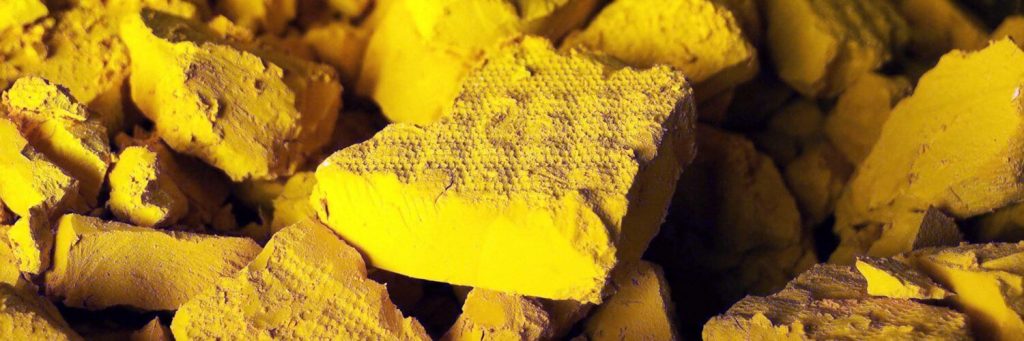
In recent weeks, a lead has been announced for creating an enriched uranium production sector, in a concentrated form commonly known as « yellowcake »[7]. If this production takes off, it could meet the need for national independence in fuel.
However, it is impossible to address the question of nuclear fuel without mentioning radioactive waste management, which remains one of the main challenges of nuclear programs worldwide. Indeed, at the end of its cycle, spent fuel remains highly radioactive and must be transported, treated and monitored strictly to prevent any release that could harm the environment. After being discharged from the reactor, the fuel is first stored in specific cooling pools, then packaged in containers reinforced with reinforced concrete to minimize residual radiation. These containers are then stored deep in underground facilities, where they will remain confined for several decades until their radioactivity decreases to levels considered safe.
The main issue lies in establishing specialized treatment and storage centers capable of confining and sustainably managing several thousand containers of irradiated fuel. Such sites require deep underground infrastructure and represent considerable investments, difficult to justify for a country with only a limited number of reactors. Therefore, a pragmatic solution is to export spent fuel to countries offering reprocessing or storage services, such as France, the United Kingdom, or Kazakhstan.
Moreover, the success of any civil nuclear program depends on the existence of a state regulatory authority. This body is responsible for ensuring compliance with safety, security, and radiological protection standards, and acts as the nuclear « gendarme ». Its role is to ensure double verification of all phases of a nuclear power plant project, from construction through startup and commissioning.
The challenge for this authority is primarily to be independent, both from the companies managing construction and supply of the plant’s equipment, and from state bodies. The authority must be able to make objective judgments on all phases of the project, and be ready to make radical decisions against economic interests. For the role of the safety authority is to ensure a project that respects all standards for human and environmental protection.
Next, a major challenge for integrating a nuclear power plant into Morocco would be modernizing the electricity distribution network managed by the National Office of Electricity and Water (ONEE). In order to maximize the benefits of a nuclear power plant, and in particular its very high capacity factor, it is necessary to improve the stability of the Moroccan electrical grid.
The proper functioning of a nuclear power plant depends heavily on the stability and modernity of the electrical grid to which it is connected. A nuclear power plant produces a large quantity of electricity continuously, but this production must be perfectly evacuated and distributed to consumption areas through a reliable and well-maintained network. If the electrical grid is unstable or poorly sized, it may become unable to absorb all the energy produced, which sometimes forces reduction of the plant’s power output, or even shutdown of a unit, which is neither optimal nor economical.
A modern grid allows for better control of frequency and voltage, which is essential to ensure that the plant’s alternators operate under safe and efficient conditions. Advanced control systems, well-maintained lines and strong interconnection with other grids limit the risks of imbalance that could directly affect the plant’s safety. Thus, the challenge for ONEE is to ensure a stable and modernized electrical grid to enable a nuclear power plant to produce electricity continuously, safely and profitably.
Finally, there is the financial question. As we have seen, a nuclear program represents a significant cost to public finances. There is therefore a challenge related to the financial arrangements needed to launch a project of this scale. Options are few, but it is clear that 100% public investment could bankrupt Morocco’s state coffers, which are spread across multiple fronts simultaneously. The impact would be all the more significant on Moroccan citizens, given that it would be taxpayers footing the bill with their own taxes.
The first realistic solution would be to rely on a Public-Private Partnership (PPP), similar to the example of the NOOR Ouarzazate solar parks (PPP between MASEN and international private investors). This format allows independent producers to resell electricity to the Moroccan government.
This is what was decided, for example, for the construction of the El Daba power plant in Egypt. The project to build 4 reactors, with a total estimated cost of between 28 and 30 billion dollars, is financed 85% by a Russian state loan. Rosatom, the Russian public nuclear company, is responsible for construction, fuel, personnel training, and provides technical support and maintenance for the first 10 years. The remaining 15% is covered by Egypt, through private investors. According to authorities, Egypt’s share will be financed « through the sale of electricity produced » by the plant[8]. This model ensures both strong Russian commitment to ensure launch, construction and technologies, and allows Egypt to mobilize private capital without relying exclusively on its public budget.
The second solution would be to finance through arrangements combining debt funds and banking support, similar to the El Wahda gas-solar combined cycle power plant project, the result of a partnership between the state and two major Moroccan banks.
Echoes from Africa and the Middle East
But none of these obstacles are impossible to overcome, as other African and Middle Eastern countries have succeeded in the nuclear gamble before Morocco and could act as pioneers.
This is the case for South Africa, which commissioned the Koeberg power plant (near Cape Town) in the 1980s, the only example on the African continent: Koeberg remains to this day the only nuclear power plant on the continent and supplies about 5% of South Africa’s electricity. This successful bet allowed the country to diversify its energy mix, historically dominated by coal, while ensuring stable and continuous production to support an energy-intensive economy. Despite challenges related to maintenance, extending its lifespan and debates on nuclear expansion, Koeberg illustrates South Africa’s ability to master this complex technology and exploit it as a lever for energy security.
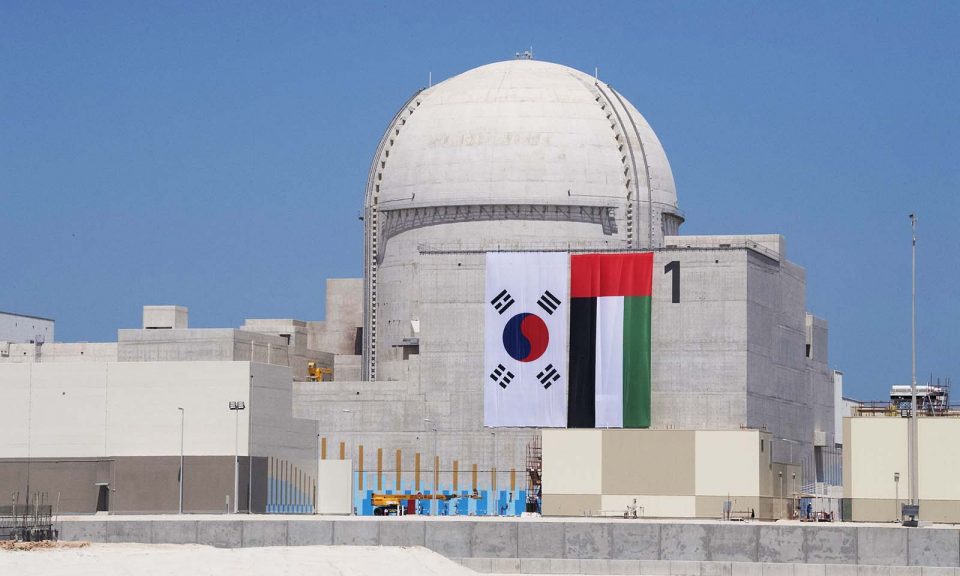
This is also the case for the United Arab Emirates, whose nuclear program is considered an exemplary success in the Arab world: with the Barakah power plant, they became in 2021 the first Arab country to produce nuclear electricity. Designed with the support of South Korea’s KHNP, the Barakah project comprises four reactors capable of providing up to 25% of the country’s electricity needs, while reducing its CO₂ emissions. Through rigorous planning, a clear legal framework and solid technological partnerships, the Emirates have successfully developed a modern, reliable and safe civil nuclear sector that supports their energy transition while diversifying their energy sources beyond oil and gas.
Reality and Energy Needs
Beyond these technical and economic challenges, it is necessary to pose the sine qua non condition before launching a civil nuclear program: Do we really need it now?
Indeed, it is legitimate to question the value of investing in the pharaonic project that is a nuclear power plant in a Morocco where several structural constraints persist.
First there is the « now ». Let us point out that it is necessary to reform the centerpiece of electricity production and distribution: ONEE. The state company has been floundering in technical and financial difficulties for several decades, and struggles to survive in a market now liberalized, facing increasingly fierce private competition. Deficit and debt have become structural in an ONEE[9] that was supposed to represent a state giant following Morocco’s independence in 1956. But a succession of decisions[10] has condemned the company to losses in the order of several billion dirhams, and has resulted in increased dependence on fossil fuels.
It would therefore be necessary to first review ONEE’s operating model, as well as its energy policy which should follow a rational path that serves Morocco’s energy transition objectives.
Moreover, it is essential to continue this reform by taking a critical look at the liberalization of the Moroccan electricity market. Privatization has always seemed to be the state’s simple solution to unlock several national issues. However, not always an effective solution.
In the case of electricity production and distribution, private investment would help meet electricity adequacy needs, by rapidly developing production capacity, particularly in renewable energy. But all this should be regulated by an uncompromising legal framework that would give greater power to the National Electricity Regulatory Authority (ANRE). The main challenge of this regulation is to avoid risks of new setbacks in the private sector, such as what we have seen with MASEN scandals involving the NOOR Ouarzazate solar plants[11].